Zara’s headphones
Anxious PeopleZara’s headphones begin as a practical suggestion from Nadia and become a conspicuous part of Zara’s way of coping when the apartment hostage crisis overwhelms her. They let her turn up death metal until it quiets the noise in her head, but they do not simply shut the world out: while wearing them, she is approached by Lennart, and their brief exchange is framed as the beginning of an unexpected connection.
Recommendation and purpose
In conversation with Nadia, Zara explains the appeal of death metal: “It’s so loud that it makes your head silent.” The remark makes the headphones’ central function legible. Their value is not just in playing music, but in offering a way to manage the internal noise that makes ordinary experience difficult.
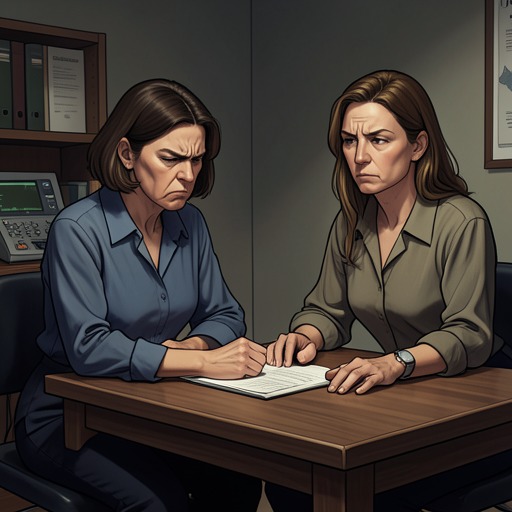
Nadia notices Zara gripping her handbag so tightly that her knuckles have turned white. She writes a note and gives it to her. Zara initially mistakes it for a prescription for sleeping pills; Nadia clarifies that it is the name of a good pair of headphones, available at an electronics store down the street. Her recommendation is deliberately practical: Zara could listen wherever she was when things began to feel difficult. Nadia also hopes the music might help Zara get out more, meet people, and perhaps fall in love. When that last possibility makes Zara withdraw, Nadia anxiously softens the suggestion, saying she only means that Zara might give herself the chance of getting fed up with someone.
The note enters Zara’s handbag beside a letter already at the bottom. She tucks it away, looks at the letter, and quickly closes the bag. The two pieces of paper are not explained as having the same purpose, but their juxtaposition places Nadia’s new, outward-facing advice beside something Zara is already carrying privately. The headphones are offered as an aid, not a cure or an obligation: Nadia suggests a means of trying something new, then worries that she has pressed too far.
Use during the hostage crisis
Later, Zara wears the headphones on the balcony of the apartment where the hostages are being held. After an emotionally unsettling encounter inside, she has gone out for air. The narrator distinguishes her outward movement from her inner state: from behind she might look impatient, but her face shows fragility. She is startled by her own loss of control and by the possibility that she has begun to feel empathy. The headphones enter this moment of attempted self-regulation, not as a sign that she is unaffected, but as one element in a larger effort to endure feelings she does not know how to handle.
Zara rubs her hands with sanitizer, counts the windows across the street repeatedly, and tries to breathe deeply. She presses herself against the building wall so that people below cannot see her over the balcony railing, clamps the headphones over her ears, and raises the volume until the music drowns out the noise in her head and its bass beats harder than her heart. Counting and music work in parallel: one gives her a repeated task, the other supplies sound powerful enough to compete with panic. The scene does not claim that either resolves her distress. It says that, perhaps, she finds a truce with herself there.
The headphones also make the boundary Zara seeks visible. She has been in the apartment too long; the other people have reduced her customary distance, and she is unused to that closeness. Against this pressure, she uses loud music and the wall at her back to create a little shelter. Yet the shelter is temporary rather than absolute. The headphones remain on when she later encounters Lennart outside, and their presence becomes the subject of his attempt to keep a conversation going.
An opening toward connection
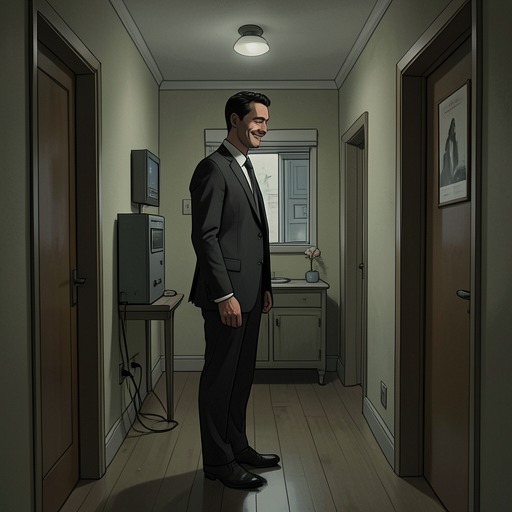
As Zara and Lennart smoke another cigarette, she is less opposed to his presence than she expected to be, though the day has already brought more new experiences than she feels ready to absorb. Her fingers trace the edges of the headphones when the rabbit’s ears waver in her direction. She expects the familiar questions men ask about work or marriage; instead, Lennart asks, “What are you listening to?” The question attends to the object she is actually wearing, rather than fitting her into one of the personal categories she resents being asked about.
Zara has much she wants to say, but answers instead that the bank robber will soon give up, that police will arrive, and that Lennart should put on a pair of pants. The headphones do not make her suddenly open or fluent. She keeps them on, turns the music up, and resumes counting windows as Lennart leaves. Even so, the exchange has crossed the distance Nadia hoped music might help Zara negotiate: someone has approached her through a question about what she listens to, and she has answered, if obliquely.
The narrator calls the encounter an unlikely love story and says that the two of them “floored each other there and then.” The headphones thus occupy a careful middle ground. They help Zara defend herself from an overwhelming inner state, but they are also part of the scene in which another person finds a way to address her. Their significance lies not in making her distress disappear, but in accompanying a fragile movement from self-protection toward contact.